Personal Reflections
Airline Analysis
Why JetBlue’s Focus on New York, Boston and South Florida Matters
By Louis de Joux
·
5 min read
JetBlue still isn't profitable, but for the first time in years its strategy hangs together. By concentrating flying on Boston, New York and South Florida, and stacking loyalty, lounges, first class and the United partnership on top, the airline is building the relevance that turns a carrier into a customer's default.

Comment Allez Blue? A bit better!
JetBlue has always had a special place in my heart. When it launched while I was in college, it helped break the connection between low cost and low quality. It was a lean airline, but it offered leather seats, convenient airports and live television at every seat.
But nostalgia does not make an airline profitable.
JetBlue has not reported a full-year net profit since 2019, and its margin remains well behind Delta and United. In Q2 2026, the airline lost $247 million and reported a negative operating margin. Fuel was a major factor: JetBlue paid an average of $4.23 per gallon, 76% more than a year earlier, and its fuel expense increased 81%.
It would nevertheless be a mistake to dismiss the quarter as simply a fuel story.
JetBlue recovered nearly half of the additional fuel expense through stronger pricing and revenue. Total revenue increased 14.5%, while revenue per available seat mile grew 10.9%. Premium RASM increased approximately 13%, and Main Cabin RASM rose 11%. Those are excellent commercial results, even if they have not yet translated into profitability.
Relevance matters more than size
The most encouraging part of JetBlue’s turnaround is not one route, product or quarterly result. It is that the airline is finally making clearer choices about where it wants to matter.
For several years, JetBlue had aircraft spread across markets where it lacked the scale to become the natural choice for local customers. The Los Angeles basin market was perhaps the clearest example. The airline offered some attractive routes and a good product, but never had enough relevance to become the primary airline for most people living there.
Airlines often explain the benefits of local scale through the "S-curve". Once a carrier reaches a meaningful level of frequency and capacity in a market, its share of passengers can grow disproportionately.
The reason is straightforward. More flights create better departure times, more destinations and more options when something goes wrong. The airline moves from being occasionally useful to becoming the customer’s default choice.
But today, the prize is much larger than passenger share.
Once an airline becomes relevant enough in someone’s home market, it can become their favorite airline, their preferred points ecosystem and eventually the credit card they keep at the top of their wallet.
A scattered collection of routes may generate revenue, but it rarely creates that habit. JetBlue does not need to be the largest airline across the United States. It needs to be useful enough in a few valuable markets that customers can choose it first for most of their travel.
Those markets are Boston, New York and South Florida.
JetBlue’s schedule increasingly reflects that decision. Reperio’s analysis of OAG data shows that the share of JetBlue flights that did not touch JFK, Boston or Fort Lauderdale declined from 26.5% in September 2023 to 18.4% in September 2026.
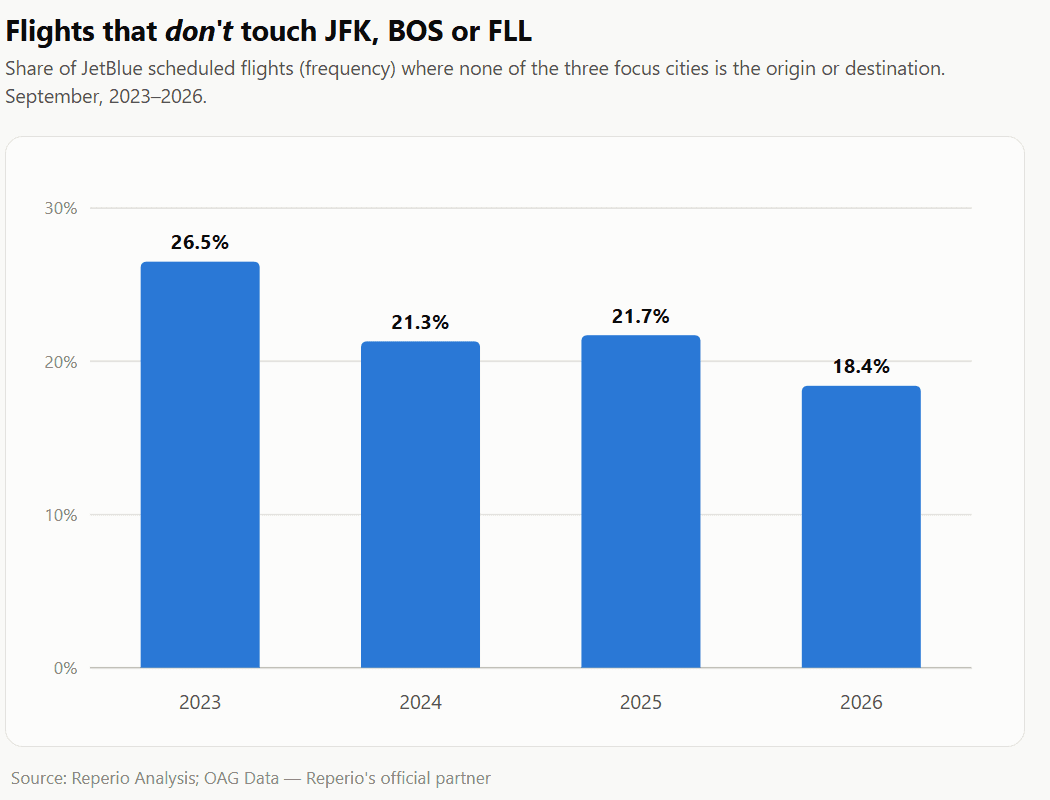
The progression has not been perfectly linear, but the direction is clear. More of JetBlue’s flying is concentrated around the cities where it has the best chance of becoming a customer’s primary airline.
Source: Reperio analysis of OAG scheduled-frequency data, September 2023–2026. OAG is an official Reperio data partner.
Three markets, three different opportunities
Boston is perhaps the most natural fit. JetBlue has a strong local identity, a broad network and an established base of loyal customers. It has lost some momentum over the years, but it still has the ingredients to become the favorite airline of a meaningful share of the market.
New York is more complicated. It is highly premium but intensely competitive, and JetBlue cannot match the global networks of the larger legacy airlines on its own.
The Blue Sky relationship with United changes that equation.
TrueBlue members can now earn and redeem points across both airlines, book flights through either carrier’s website and receive reciprocal benefits including priority services, preferred seating and a checked bag, depending on status. United adds an expansive domestic and international network to JetBlue’s proposition.
This is especially useful in New York. JetBlue brings its JFK network, while United provides enormous breadth from Newark. A New Yorker can choose JetBlue where it is strongest and remain connected to the same broader loyalty proposition when United better serves the destination.
That makes TrueBlue more credible as a primary points ecosystem. JetBlue does not need to fly everywhere itself if its customers can continue earning, redeeming and receiving benefits through United.
South Florida may be the most exciting opportunity of the three.
JetBlue grew Fort Lauderdale capacity by nearly 40% in Q2, yet RASM in the market still increased 11%. Growing that quickly without destroying unit revenue is remarkable. The airline now plans to offer more than 150 daily departures from Fort Lauderdale this winter.
Spirit’s shutdown has made the opportunity even larger. JetBlue can build much of the South Florida relevance it wanted from the proposed Spirit acquisition without taking on the entirety of Spirit’s airline and balance sheet.
The product also suits the market. South Florida is affluent and has a significant cruise and leisure customer base, yet it has historically had fewer compelling lie-flat transcontinental options than New York or Boston. JetBlue can combine a broad leisure network with Mint and a product that is more attractive than that of a traditional ultra-low-cost carrier.
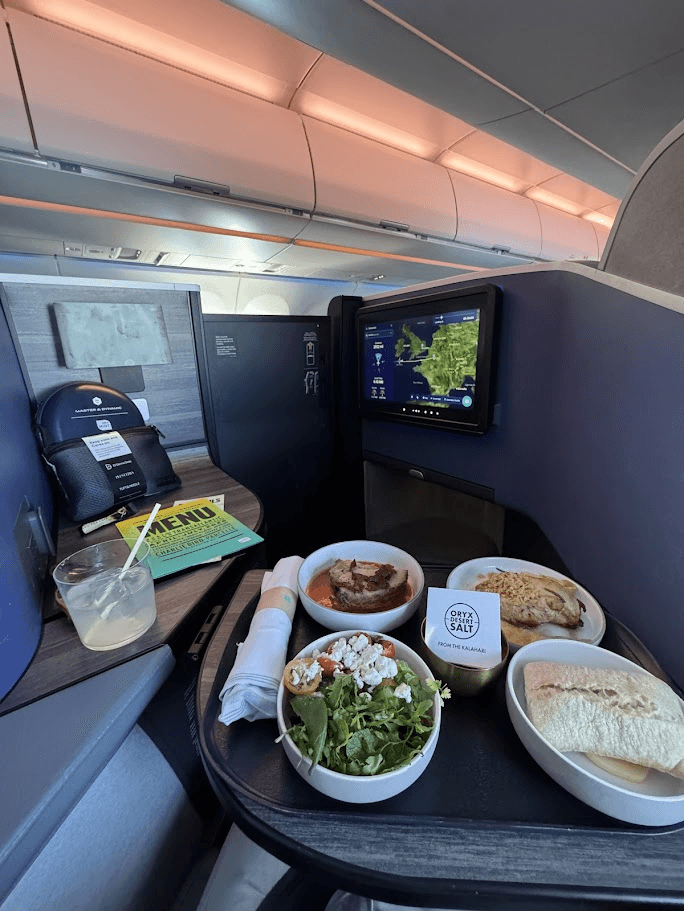
Jetblue's lie-flat product is a hit in South Florida
From network relevance to top of wallet
The loyalty results show why this concentration matters.
JetBlue’s loyalty revenue increased 13% in Q2. New premium-card acquisitions rose nearly 40%, while loyalty cash remuneration increased 21%.
These figures should not be separated from the network strategy. A JetBlue credit card becomes much more attractive when JetBlue is genuinely useful in the customer’s home market.
The network supports TrueBlue. TrueBlue gives customers another reason to choose JetBlue. The credit card then brings their everyday spending into the ecosystem. Each element strengthens the others.
JetBlue’s new BlueHouse lounges give the strategy a physical expression. The airline opened its first BlueHouse at JFK and expects to open its second in Boston this summer.
BlueFirst, JetBlue’s forthcoming domestic first-class cabin, is another important part of the strategy. JetBlue has long had a strange gap between the excellent Mint product and aircraft with only an economy cabin. BlueFirst will begin flying this fall, although modifying the wider fleet will naturally take time.
The network, lounges, loyalty program, credit card and onboard product are finally starting to tell the same story.
Not a victory lap
JetBlue remains financially challenged. It expects an adjusted operating margin of negative 2% to negative 5% for 2026. Its target of earning at least $1 per share in 2028 also assumes continued demand strength and fuel averaging $3 per gallon.
There is still a large margin gap to close. JetBlue must control costs, maintain operational reliability, complete its product investments and prove that Fort Lauderdale’s rapid growth is sustainable.
But the individual pieces now fit together.
A more concentrated network. Greater relevance in Boston, New York and South Florida. A much more useful loyalty proposition through United. New lounges. A domestic first-class product. And a credit card that increasingly has a reason to move to the top of the customer’s wallet.
JetBlue has not completed its turnaround. But for the first time in several years, the strategy is becoming much easier to believe in.
Airline Analysis

Travel consulting & U.S. market entry.
© 2026 Reperio LLC. All rights reserved.